


Employee Benefit Plan Services
Overview
Protect Your Plan. Empower Your People.
Beyond compliance, our audits strengthen your benefit plan’s value – securing compliance and helping you deliver a better benefit to your employees.
Hiring a plan auditor isn’t just about checking a compliance box, it’s about protecting your plan and positioning it for success. With specialized expertise and decades of EBP experience, Boyer & Ritter ensures your plan passes regulatory scrutiny while helping you strengthen plan operations, manage risks, and drive value for your employees.
Comprehensive Employee Benefit Plan Audit and Advisory Services
- Benefit plan advisory services
- ERISA Benefit Plan Audits (Full & Limited Scope): Independent audits for 401(k), 403(b), pension, ESOP, and health/welfare plans, including ERISA §103(a)(3)(C) (limited-scope) and standard audits, ensuring compliance with DOL & IRS requirements
- Form 5500 and Form 990 tax return preparation
- Regulatory Consultation & Support: Guidance on ERISA compliance, assistance with Department of Labor and IRS audits/inquiries, and support in implementing self-corrections, so you can navigate issues confidently
Our Approach: More than a Compliance Checklist
Our dedicated EBP audit team blends deep technical expertise with a forward-looking approach. We don’t just audit, we partner with you to improve your plan’s health and performance. Our goal is to make the audit an opportunity to tighten your internal controls, enhance fiduciary oversight, and maximize plan benefits for your employees.
Frequently Asked Questions
An employee benefit plan audit is generally required when the plan has 100 or more participants with account balances at the beginning of the plan year (a rule change effective for plan years beginning on or after January 1, 2023). Plans near the threshold should also consider the 80/120 participant rule, which can affect whether the plan files as “small” or “large.” Boyer & Ritter helps plan sponsors confirm the correct count and determine which audit approach applies.
The 80/120 rule provides filing stability for plans hovering around the 100-participant threshold. In certain situations, a plan that previously filed as a small plan may continue filing as a small plan even if participant counts rise above 100 (up to 120), depending on prior-year filing status and other conditions. This is a common source of confusion, so sponsors should confirm eligibility before assuming an audit is or isn’t required.
An ERISA Section 103(a)(3)(C) audit (formerly called a “limited-scope” audit) allows the auditor to rely on investment information certified as complete and accurate by a qualified institution (such as a bank or regulated insurance carrier). Under current standards (SAS 136), auditors issue an opinion while performing required procedures on non-certified areas and ensuring the certification is properly obtained and evaluated.
Plan administrators are responsible for determining whether the 103(a)(3)(C) election is permissible and for obtaining a proper certification from a qualified institution that states the investment information is complete and accurate. Sponsors also remain responsible for the financial statements and disclosures, including how certified investments are measured and presented. Many sponsors document their evaluation process to support compliance.
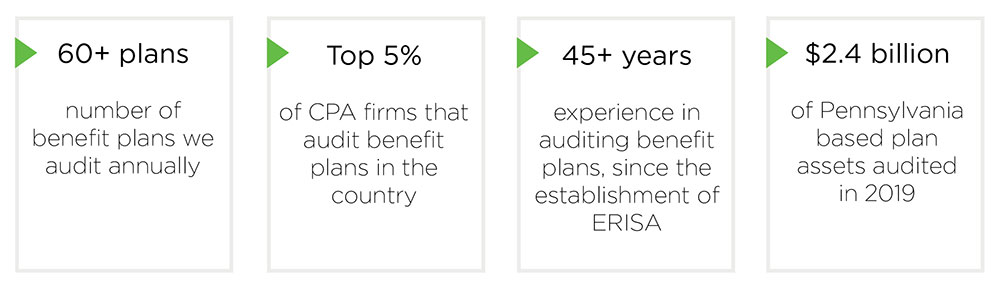
Boyer & Ritter audits plans of many types and sizes, including defined contribution, defined benefit, ESOPs, 403(b), multi-employer, and health and welfare plans. Plans we audit range from those with around 100 participants to those with several thousand participants and more than $40 million in plan assets.
Yes. Boyer & Ritter has a dedicated employee benefit plan (EBP) services team focused exclusively on the unique regulatory, operational, and fiduciary requirements of benefit plans. Our team combines deep technical knowledge with practical, hands-on experience to help plan sponsors meet compliance requirements while minimizing risk and disruption. Our employee benefit plan audits are led and supported by professionals who work extensively with 401(k), 403(b), and other ERISA-governed plans across a wide range of industries. This specialized focus allows us to stay current on evolving Department of Labor (DOL) regulations, auditing standards, and industry best practices.
Hiring the plan auditor is a fiduciary function, and audit quality matters because deficient audits can increase the risk of DOL scrutiny, filing issues, and costly corrections. Boyer & Ritter's experienced EBP audit team helps plan sponsors identify common operational errors (like late remittances or documentation gaps) before they become larger problems.
Yes. In addition to EBP audits, Boyer & Ritter provides consultation and assistance regarding ERISA issues and support related to DOL and IRS inquiries and examinations.

Boyer & Ritter is a member of the AICPA’s Employee Benefit Plan Audit Quality Center (EBPAQC), a voluntary program focused on improving EBP audit quality through firm-level commitment, training, and best practices. For plan sponsors, EBPAQC membership is a meaningful signal that the audit team is staying current in a highly regulated area.
Yes. If a plan falls below the audit threshold under the updated participant-count rules, sponsors may still want reassurance that plan operations and compliance processes are strong. Boyer & Ritter can perform a Small Plan Operational Review/Health Check focused on areas commonly identified by regulators, even when an audit is not required.
Ready to protect your plan and empower your people? Let’s discuss how Boyer & Ritter’s EBP team can help your organization. Use the form on this page to Contact our EBP specialists for a plan assessment or to schedule your next audit.
Memberships
News & Events
Articles
Events
News
Tax & Fraud Alerts
Multimedia

Resources
Resources
2026 Benefits Reference Guide (PDF)
Audit Expectations (PDF) - coming soon
Employee Benefit Plan Checklist for Record Retention (PDF)
IRS – Employee Benefit Security Administration
Contact
-
Request More Information
Professionals
Related Industries